10 Minute Routines for French Conjugation Practice (A1 to C2)
The most effective way to master French conjugations is short, production-focused drills combined with reviews timed to bring each form back before you forget it, rather than passive rule memorisation. The sections below show which exercises to use, how to structure a weekly plan, and how to fix the errors that trip up most learners. LanguaCards runs this routine for you with conjugation packs and reviews timed to each form.
What this article covers
- The best French verb conjugation exercises
- How to structure your weekly practice
- Sample routines for every level and time budget
- Fixing the errors that show up again and again
- Why timed review and audio make practice stick
- Which tenses to practise first
The best French verb conjugation exercises
Not every exercise builds the same skill, and that is the mistake most learners make. You need a mix, and each type earns its place for a specific reason.
Fill-in-the-blank and typed-answer exercises force retrieval instead of recognition. When you have to type j'ai mangé instead of picking it from four options, your brain reconstructs the form rather than just recognising it. That retrieval effort is what cements the pattern, and it is why typed production outperforms simple flashcard flipping for long-term recall.
Flashcards with timed review handle the marathon, not the sprint. You see a verb form again right before you are likely to forget it, which is what keeps je finis and elle finira from sliding out of memory a week after you learned them.
Speaking drills and audio shadowing close the gap between knowing a form and producing it under pressure. Reading nous voudrions silently is easy. Saying it out loud, matching the rhythm you hear, is where conditional forms actually stick.
Conjugation tables are for spotting patterns, not brute-force memorising. Lay out all six persons of an irregular verb like prendre side by side and the stem change becomes visible instead of abstract: je prends, nous prenons, ils prennent.
- Fill-in-the-blank: builds recall speed for common forms
- Typed production: forces full retrieval, not guesswork
- Flashcards with timed review: locks in retention over weeks and months
- Speaking drills: trains pronunciation and real-time fluency
- Conjugation tables: reveals stem patterns across irregular verbs
Once you know the forms, mixing tenses beats drilling one tense in isolation, because switching between them trains the choice you actually face in conversation.
One tip. Start a new tense with three to five days of single-tense focus, then switch to mixed drills. Jumping straight into mixed practice before you know the forms just multiplies your error rate.
How to structure your weekly practice
A practice plan works when it is built around three moving parts: what you study, in what order, and how often you review it. Here is a framework you can copy.
- Pick items by frequency and trouble spots. Prioritise the tenses you will actually hear and use. Everyday French leans on a small handful of core tenses, so present, passé composé, imparfait and futur simple deserve far more repetitions than the passé simple.
- Sequence from focus to mix. Spend the first few sessions on one tense alone, then blend it with tenses you already know, then rotate it into cumulative review across everything you have studied.
- Space your reviews deliberately. A new form comes back the next day, then in three days, then a week, then two to three weeks, stretching further each time you get it right. Miss one and the gap resets to the shortest interval.
- Track accuracy, not just completion. Log your correct-answer rate per session. Below 80% on a tense is your signal to slow down and go back to single-tense drills before mixing it back in.
Sample routines for every level and time budget
Your schedule should match your actual free time, not an idealised version of it. These three routines work at any level, adjusted by how much time you spend on production versus review.
- 10 minute daily loop: clear your review queue first, then produce five sentences using new or shaky forms. This is the minimum dose that keeps retention from decaying.
- 20 to 30 minute focused session: one tense drill block of 10 minutes, one sentence-production block of 10 minutes, then a short speaking or shadowing exercise of 5 to 10 minutes.
- Weekly cumulative review: once a week, run a mixed-tense session across everything from that week, plus a longer speaking practice, 15 to 20 minutes.
If you are preparing for an exam, weight your sessions toward written accuracy and agreement rules. If your goal is conversation, weight toward speaking drills, since fluency under pressure matters more than perfect spelling.
Fixing the errors that show up again and again
Certain mistakes repeat across almost every learner, and most have a quick diagnostic attached.
- Avoir or être. Most verbs take avoir in compound tenses. A small fixed list of movement and change-of-state verbs (aller, venir, arriver, partir and a few others) takes être. Memorise the list, not the exception.
- Past participle agreement. With être, the participle agrees with the subject. With avoir, it agrees with a preceding direct object, which usually only appears with pronouns like que or les.
- Irregular stems. Group by pattern instead of memorising each verb separately. Prendre, apprendre and comprendre share the same stem shifts.
- Subjunctive or indicative. The trigger phrase decides it. Expressions of doubt, wish or necessity (il faut que, je doute que) call for the subjunctive; statements of fact use the indicative.
One tip. When you keep missing the same verb and person combination, break it down: isolate the stem, drill the ending pattern, then rebuild the full form inside a sentence. Skipping straight to full sentences is usually why the error keeps recurring.
Why timed review and audio make practice stick
The reasoning is straightforward. Retrieving a form from memory beats reading it passively, and hearing it while you produce it trains the sound and the grammar at the same time.
LanguaCards builds its conjugation packs around that idea:
- Reviews timed to bring each form back right before you would forget it
- Audio on cards, so pronunciation trains alongside grammar
- Packs covering A1 to C2, so you are not drilling forms above or below your level
- Conjugation packs that group irregular verbs by pattern rather than listing them alphabetically
A 14 day plan might look like this: days 1 to 5 on present tense high-frequency verbs, days 6 to 10 adding passé composé with auxiliary-selection drills, and days 11 to 14 mixing both tenses into cumulative review with some shadowing built in. You can run that plan in LanguaCards, which has conjugation practice across four tenses.
Which tenses to practise first
You do not need to drill every French tense with equal weight, and treating them as equally urgent wastes time. Start with the present, since it carries the highest frequency in everyday speech and forms the base for patterns you will reuse elsewhere.
From there, add passé composé and imparfait together, because you will constantly choose between them when talking about the past. Passé composé marks a completed action; imparfait describes background or ongoing states. Learning them side by side trains the actual decision you face in conversation. For a fuller breakdown, this comparison of passé composé and imparfait walks through concrete examples.
Futur simple comes next, since it is common in both speech and writing and shares stem patterns with the conditional. Once those four are solid, move to the subjunctive, focusing on trigger phrases rather than memorising every form cold. The conditional and imperative can follow soon after, since both borrow from forms you already know.
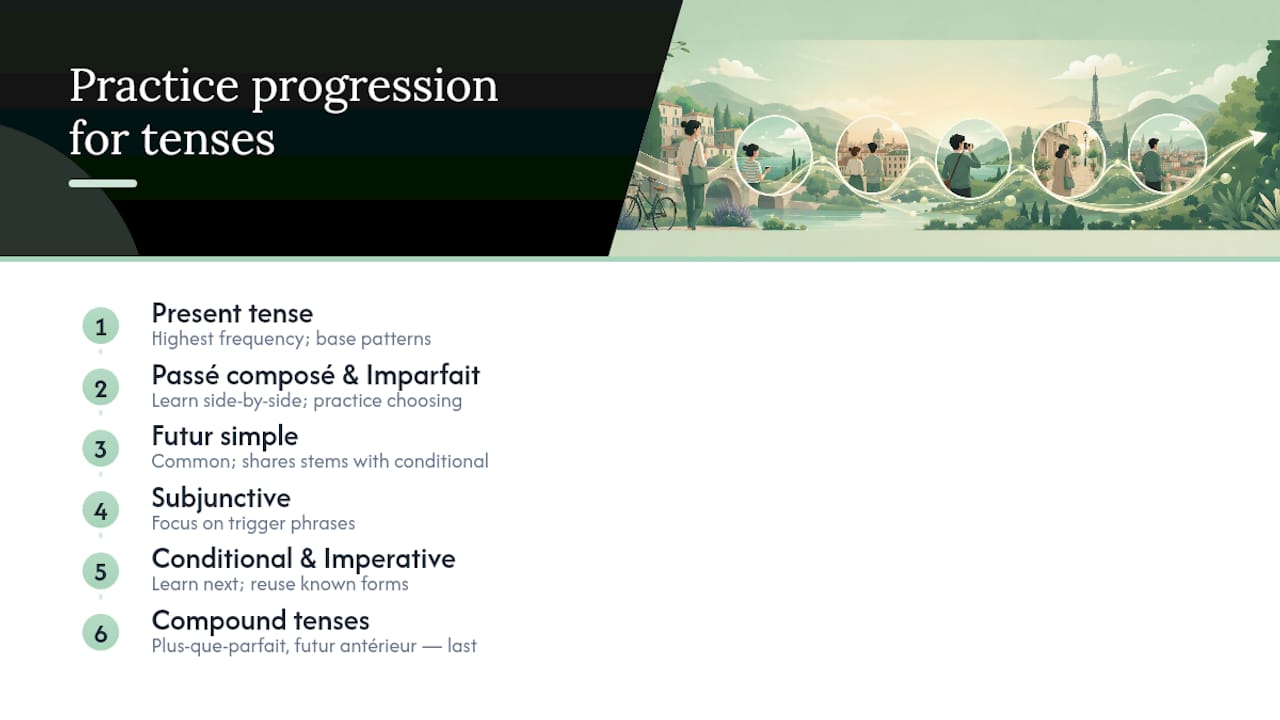
Compound tenses like plus-que-parfait and futur antérieur belong later, once the foundational tenses are automatic. Layering them in too early just adds noise to forms you have not stabilised yet.
Build the habit, not the marathon
The learners who improve fastest are not the ones who study longest. They are the ones who show up daily for ten focused minutes instead of cramming ninety minutes once a week. Consistency beats intensity almost every time with conjugation drills.
Two habits matter more than any exercise type: keep your daily review queue small enough that you will never skip it, and always produce at least one full sentence out loud before you close the app.
Put the plan into practice
LanguaCards is built for the routine this article describes: short daily reps, real production, and review timed to when you are about to forget a form rather than after you already have.
Inside the app you get reviews that resurface weak verb forms, audio and images on cards, packs covering A1 to C2, conjugation packs grouped by irregular pattern, and verb conjugation practice you can run on its own.
Free packs and conjugation practice are included at no cost, and the first 24 hours after downloading are fully unlocked.
Download LanguaCards and start practising French conjugation, or browse the French phrase dictionary for example sentences to anchor the forms you are drilling.